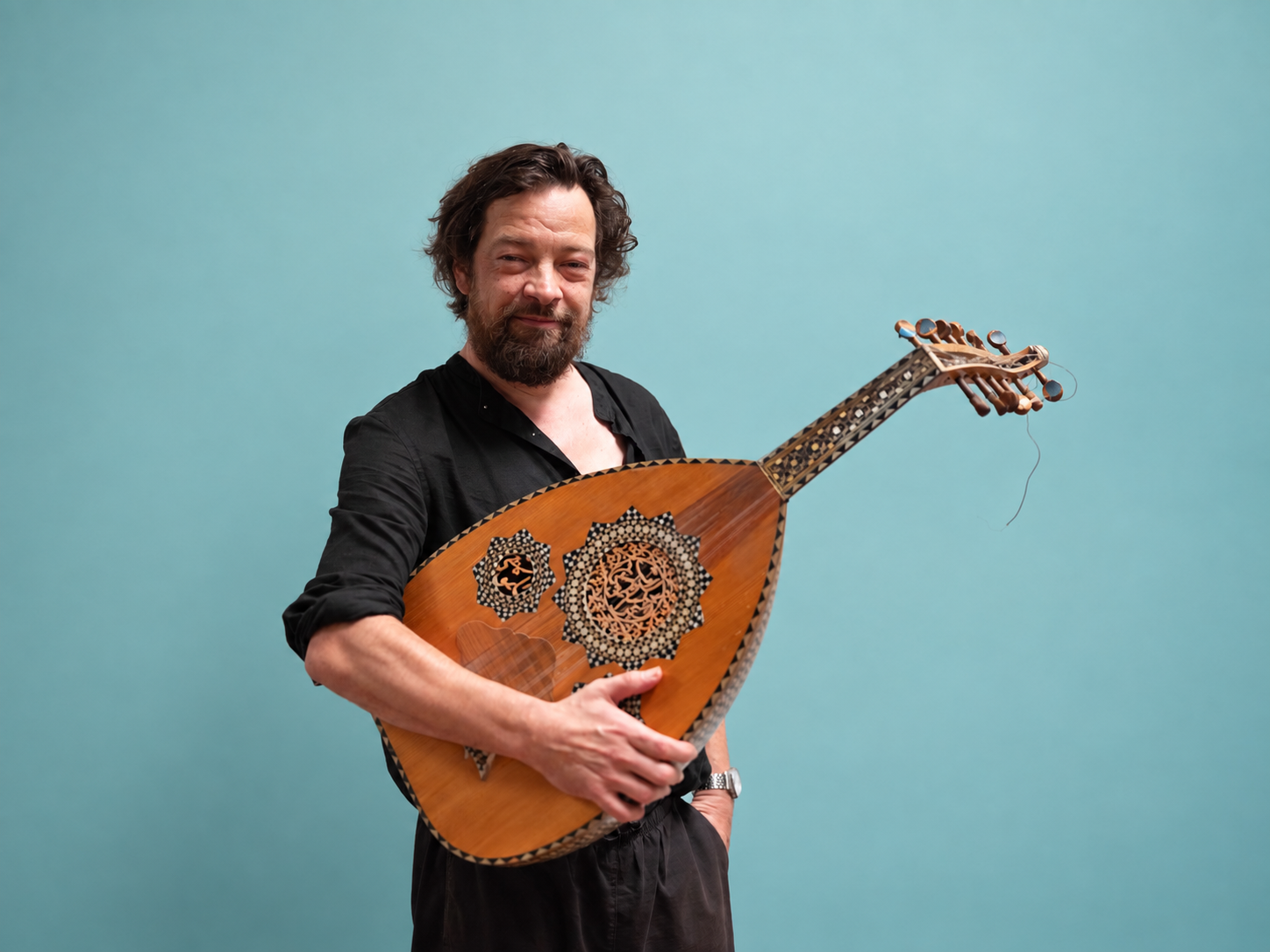
Peter Verhelst approaches performance as a meeting place: between word and sound, preparation and risk, one musician and another. In this provisional conversation, he reflects on the space surrounding The Eagle Has Landed.
The Eagle Has Landed is a striking title. What does it open up for you?
For me, a title should not explain the work before it begins. It should create a field of tension: something has arrived, but we do not yet know whether it is a message, a warning or an invitation. The music can then move inside that uncertainty.
What happens when words meet the oud?
The oud carries time in a very physical way. A note can feel ancient and completely present at once. I am interested in the moment when language stops describing and starts behaving like sound—when a sentence becomes rhythm, breath or resistance.
How does Bjorn Eriksson change the shape of the performance?
A collaboration changes the temperature of every decision. Instead of illustrating one another, we listen for the space that appears between two distinct voices. That space is often where the performance becomes most alive.
How much of the evening is fixed in advance?
There is a structure, but it needs room to breathe. We know the landscape and a number of possible routes through it. The audience, the acoustics and the concentration in the room determine which route becomes possible that night.
What would you like the audience to take away?
Not a conclusion. Perhaps only the sensation that something briefly shifted—a familiar word, a sound, or the scale of the room. If that feeling remains for a little while after the last note, the work has done enough.